 Superrare
 brings digital artworks, editions, and physical releases into one marketplace
Superrare is an art marketplace with distinct release formats for digital artworks and physical objects. A one-of-one work is unique, while a fixed edition contains multiple copies of one artwork. Liquid Editions connect art to interchangeable ERC-20 tokens and a shared trading market. Physical releases add another distinction: creators handle Physical Included fulfillment, while supported managed prints use platform-arranged production and shipping. Collectors can connect an existing wallet or receive an embedded wallet through supported sign-in options. Credit cards work only for eligible USDC fixed-price purchases, so the artwork format, selling method, and fulfillment arrangement affect the available experience.
updatedIn this guide
In short: Physical Included releases use creator-managed fulfillment, while supported managed print releases place production and shipping with the marketplace.
Unique artworks, fixed editions, and blind mint collections
One-of-one artworks, fixed editions, and blind mint collections give creators different ways to release work, with different information available to collectors. A collection can contain original 1/1 artworks that release individually. A fixed edition contains multiple copies of one artwork within a defined edition size. The artist sets edition pricing, while the artwork page shows the listed price and release availability. Edition size describes the release's supply; it does not tell a collector how many copies remain available.
Blind mint collections keep artworks unrevealed at minting and reveal them afterward through the release's reveal mechanic. These formats sit alongside Liquid Editions in marketplace discovery.
Liquid Editions and the shared ERC-20 market
Liquid Editions pair an artwork with fungible ERC-20 tokens, giving collectors a position in a shared market connected to that work. The balance is part of the artwork's structure, and the artist defines what participation means.
Token supply is fixed at launch, although its size varies by project. A fixed supply does not fix the trading price: liquidity and demand influence pricing as collectors buy and sell.
The artwork can remain a static image or video. Market participation does not require the artist to add generative or interactive behavior.
The market layer includes supply, balances, trades, and liquidity. The artwork layer contains the image, metadata, or rendering logic that collectors encounter.
Some projects connect token activity to a wider artistic concept. NORML by Jiwa uses token ownership and participation to reveal parts of a networked body of work. Value Discovery by ripe uses disagreement between liquidity pools as a visual input.
Liquid Lenses and artwork that changes with onchain activity
Liquid Lenses are optional ERC-721 companion collections that can interpret a Liquid Edition's market activity through separately collectible artworks. Adding a Lens and making the art dynamic are separate choices, so either layer can remain static.
Where the artwork can change
Art attached to a Liquid Edition
The artwork attached to the ERC-20 can respond directly to onchain information. Its render logic may use trades, transfers, or other project-specific state. An artist can create that behavior without adding a companion ERC-721 collection.
An optional Liquid Lens collection
A connected Lens can render its own view of the same Liquid Edition. HTML allows interaction, sound, animation, and browser-based rendering. HTML alone does not connect those features to trading activity; the artist must design the artwork to read or receive the relevant state.
State changes and metadata refreshes
Dynamic artwork needs relevant state and rendering behavior that interprets it. After that state changes, a metadata refresh by the marketplace or another client can let the render logic produce an updated view. Wallets and apps also differ in their support for displaying the artwork.
Liquid Edition trading, liquidity, and slippage
Liquid Edition trading uses liquidity mechanics, so collectors do not need to wait for a separate NFT resale listing. The shared market can support buying and selling around the clock when market conditions and available liquidity allow.
Slippage settings limit the price movement that a trade will tolerate before confirmation. A transaction can fail when the price moves beyond that setting while confirmation is pending. Newer contracts or routers can also trigger wallet warnings. Checking the selected contract before approval helps distinguish the intended artwork's market from another contract.
Fixed prices, auctions, and offers
Fixed-price listings, auctions, and offers provide different selling mechanisms for eligible work. A fixed-price listing states the asking price before purchase. Auctions distinguish scheduled, live, and closed states, with live bidding during the active period. Supported auction views show the current bid, bid history, and a closing countdown. Offers let collectors express interest even when an artwork lacks a current listing, without requiring a public list price.
Live Auction Chat lets artists, collectors, and the community discuss work during supported auctions. Collectors who already own artwork on Superrare can also sell it through the marketplace, so selling is not limited to newly created work.
Can collectors sign in without an existing crypto wallet?
Collectors can sign in with Google, email, or supported social accounts and receive an embedded smart wallet without bringing an existing crypto wallet. The marketplace also supports connecting an existing wallet. Collected work goes into the embedded wallet or the existing connected wallet, depending on the access path. The chosen sign-in method does not determine which payment methods a release supports.
Credit-card checkout and eligible USDC purchases
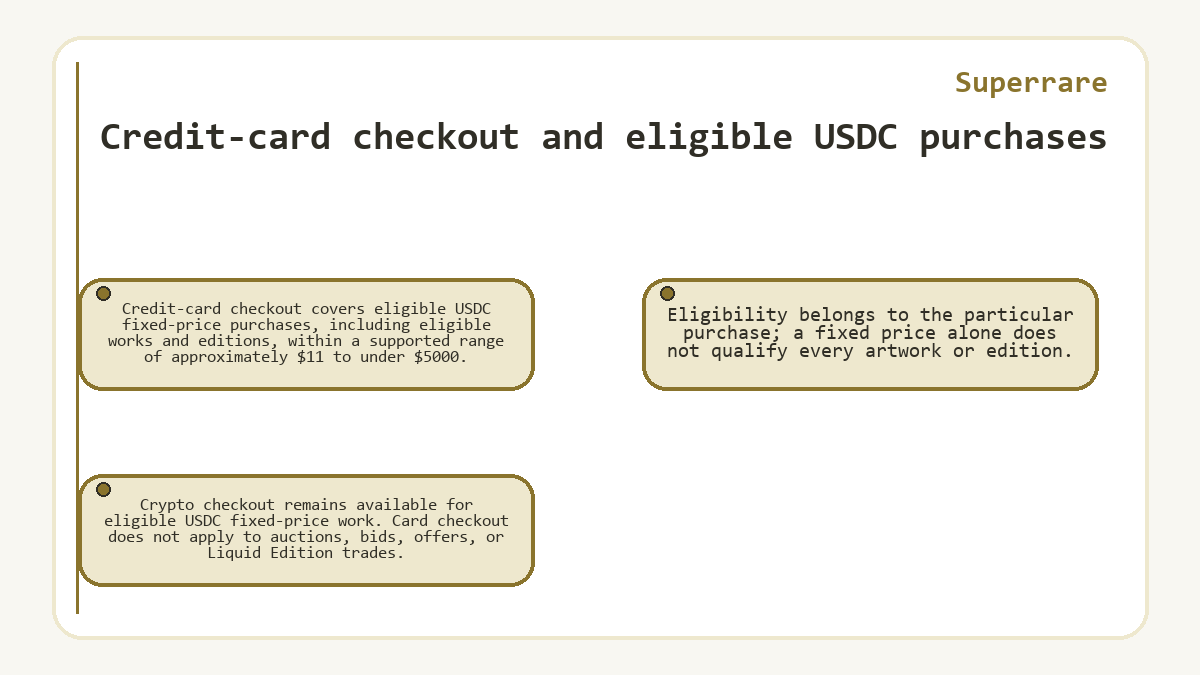
Credit-card checkout covers eligible USDC fixed-price purchases, including eligible works and editions, within a supported range of approximately $11 to under $5000. Eligibility belongs to the particular purchase; a fixed price alone does not qualify every artwork or edition. Crypto checkout remains available for eligible USDC fixed-price work.
Card checkout does not apply to auctions, bids, offers, or Liquid Edition trades.
Physical Included items and managed print delivery
Physical Included items leave fulfillment with the creator, while supported Managed Print Service releases assign fulfillment to Superrare. Physical artwork can pair a tangible object with a digital art receipt.
Creator-managed physical items
Approved creators can add physical details to an eligible artwork after minting, directly from its artwork page. Those details can cover medium, dimensions, shipping information, notes, and supporting media. The creator coordinates production, shipping, delivery, condition, and communication with the collector.
Supported managed print releases
Managed print projects require release-specific planning and configuration. Superrare collects delivery details through the configured purchase experience and handles production, distribution, and shipping for supported print formats. Books, sculptures, installations, and custom objects follow the broader physical-release path, outside the managed print service.
Worked example: A print with platform-arranged shipping
In this hypothetical case, a collector wants a print and requires Superrare to arrange its production and shipping. The question is whether a Physical Included label meets that requirement.
Physical Included makes the creator responsible for coordinating fulfillment, so the label alone does not meet the requirement. A supported Managed Print Service release does meet it because Superrare handles production, distribution, and shipping. The release must actually have that managed configuration; being a physical artwork or print is insufficient.
Artist approval and Rare Protocol creation routes
Approved artists can create fixed editions through the edition flow, while Liquid Edition creation also depends on available access and configuration. Whitelisted artists can use the guided Liquid Edition create flow or the Rare Protocol command-line interface (CLI). The guided route supports a standard launch; the CLI serves projects that need more technical control.
Whitelisted artists using the CLI should deploy from the wallet connected to their artist profile so the work can surface in the marketplace. Builders outside the artist whitelist can also use Rare Protocol through the CLI. Those builders should expect to handle their own launch, promotion, and audience-building. Protocol access does not include standard marketplace, profile, editorial, or launch support by default.
Artist profiles, collections, and marketplace discovery
Profiles and collections organize artworks, while search, filters, activity feeds, and related-art views give collectors different discovery routes. Curated release pages, exhibitions, gallery presentations, and partner-led presentations offer other ways to present a project when arranged. Publication alone does not secure homepage placement, editorial coverage, or a sale.
Supported release configurations can credit collaborators and allocate revenue through splits. A collaborator credit alone does not specify royalties or a payout arrangement. Curated editorial and promotional support remain separately determined, beyond a work appearing through ordinary marketplace surfaces.
SuperRare Studio for hosted art experiences
SuperRare Studio provides a separate place to build and host portfolios, minting pages, 3D galleries, games, and interactive experiences. Creators can start from a guided brief or bring a finished site. The presentation can use a Studio address or custom domain, giving the work a dedicated setting outside a standard artwork page. Connection to the marketplace economy can come later, when the creator is ready.
Superrare - your questions answered
Why does my wallet show a token balance instead of the Liquid Edition artwork?
A wallet may show a Liquid Edition's ERC-20 balance without displaying its full artwork. If the project includes a Liquid Lens or Companion 721, those ERC-721 artworks may appear separately like other NFTs. Liquid Editions can also publish ERC-1046 token metadata, which compatible clients can use. Artwork display depends on the wallet, marketplace, or app and its support for that metadata.
How does holding more Liquid Edition tokens affect the artwork?
Holding more tokens affects the artwork only when the particular project gives balances that role. Some Liquid Editions use larger holdings to change visuals, reveal more of the work, influence later phases, or alter a collector's role. Other projects treat the additional tokens as a larger position in the same artwork. The artist's project description should explain which meaning applies.
Can I launch a Liquid Edition from a JPEG or MP4 without coding?
A JPEG or MP4 is enough for a whitelisted artist to use the guided Liquid Edition creation flow without writing code. Dynamic art, Liquid Lenses, and generative behavior remain optional. Artists who want custom technical control can use the Rare Protocol CLI, while access to the guided marketplace flow follows its artist eligibility requirements.
Which updates can arrive by email or browser notification?
Email and browser-push delivery depend on configured notification types and the collector's settings. The marketplace supports in-app notifications, with configured updates for sales, auctions, offers, follows, and mints. An in-app update can arrive without a matching email or browser-push alert.
Does every auction show a watching indicator?
Watching indicators appear on supported auction pages, with some views showing when several collectors are watching. Watching describes viewing activity; bid history records bids.